



Blog Post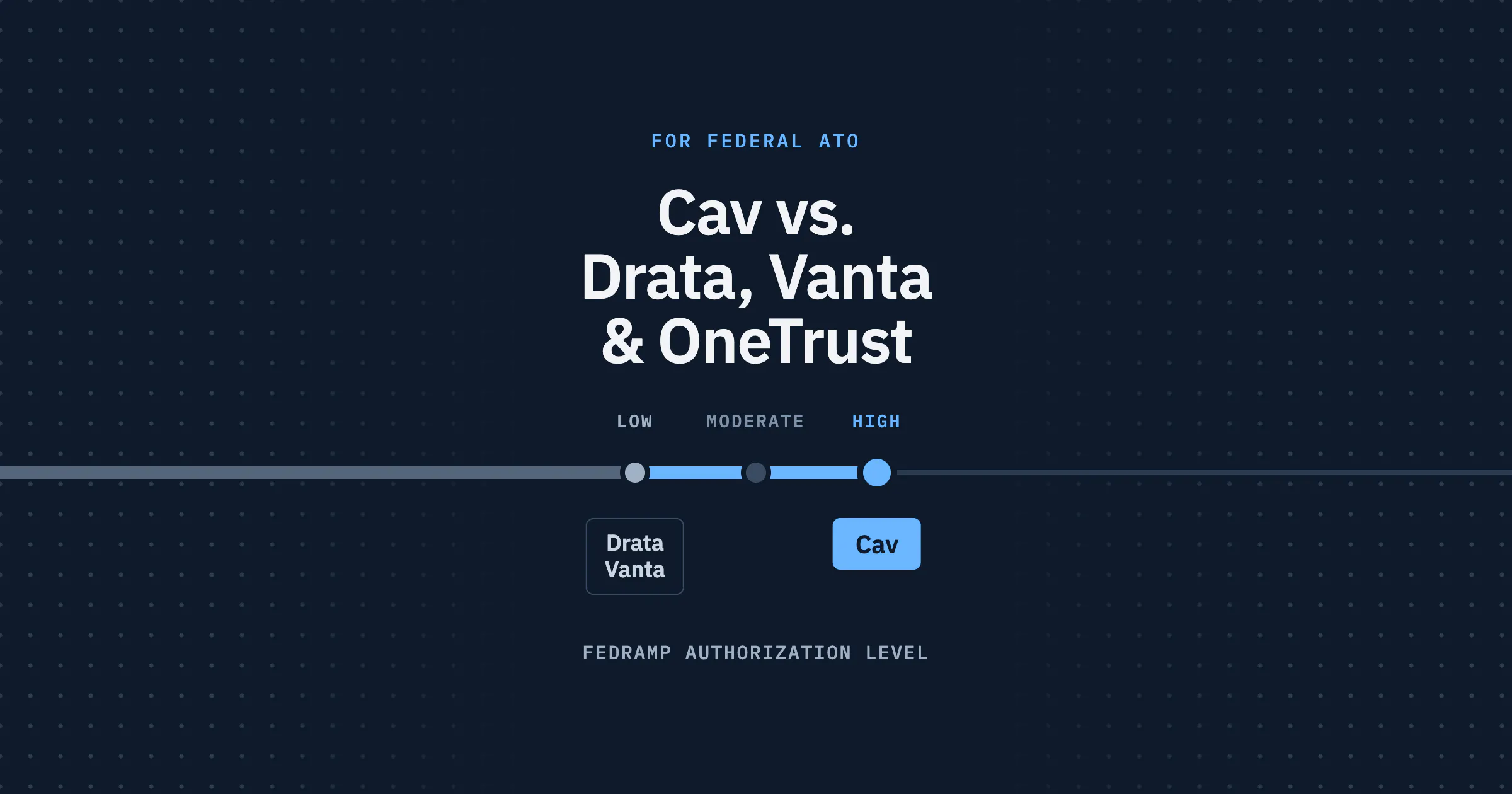 Read more
Cav vs. Drata, Vanta, and OneTrust for Federal ATO
Read more Blog Post

Cav's Continuous Controls Monitoring is built to satisfy the ongoing oversight model that regulators expect from insured depository institutions. The FFIEC IT Examination Handbook Management booklet lays out IT risk management in four stages: identification, measurement, mitigation, and monitoring and reporting. That framing makes ongoing monitoring a baseline examiner expectation rather than a best practice. The FDIC examines banks under a risk-focused approach to assess safety and soundness, and as of September 30, 2025, it was the primary federal regulator for 2,772 of 4,379 insured institutions, according to FDIC Statistics at a Glance. The FDIC's second quarter 2026 Quarterly Banking Profile covered 4,238 insured banks and savings institutions, as reported by the ABA Banking Journal, which signals the scale at which compliance gaps carry material risk.
Cav's Compliance OS platform responds to this environment through real-time evidence ingestion, automated control mapping, and continuous monitoring rather than a single point-in-time review. This matters because Call Reports are still submitted quarterly, meaning evidence collected only at audit time may not reflect the institution's actual posture between reporting dates. Compliance OS can typically be deployed within one month with minimal training, according to Cav's financial services page, giving compliance teams an always-on alternative to manual, spreadsheet-based audit cycles. The platform is authorized to protect government workloads at the FedRAMP High level, per its FedRAMP Marketplace listing, a credentialing threshold that signals the security rigor regulated financial institutions require.
Financial institutions typically manage obligations across multiple frameworks simultaneously, and Cav eliminates the redundant work of maintaining separate control libraries for each. Cav's automated control mapping maps controls across 100+ compliance frameworks and certifications, applying a "test once, comply many times" model that carries a single control validation across all applicable frameworks. For financial services specifically, Cav's financial services page calls out explicit coverage for CRI, PCI, DORA, SOC 2, and 50+ other cyber compliance frameworks, matching the audit calendar that CISOs and CROs at mid-market banks manage.
The platform supports this through 100+ integrations and APIs, spanning SIEM, SSO, SCIM, EDR, CSPM, CNAPP, OT/IoT, and vulnerability management tool categories. Automated evidence collection compiles findings from these sources and adds new sources quickly through API integrations, which means the control library stays current as the institution's technology stack changes. Cav uses Model Context Protocol (MCP) to move data among AI agents, cloud computing, and external applications, as noted on Cav's homepage, providing the open architecture necessary for hybrid and multi-cloud banking environments. Every finding is traceable and verifiable through Cav's Inspector and Evidence Explorer tooling, according to the Compliance OS launch announcement, which supports the audit trail that examiners expect to review.
Manual audit preparation is a documented source of examiner findings, and Cav replaces that process with automated evidence pipelines tied to a real-time executive dashboard. Cav's automated reporting delivers 95% evidence automation and 90% faster audit cycles, metrics that directly reduce the labor and latency that produce gaps in examiner-facing documentation. The reporting interface surfaces overall compliance score, framework status, trend analysis, alerts, control coverage metrics, and findings organized by severity, status, and application, as shown on Cav's homepage. This gives CISOs and CROs the visibility to identify and remediate control gaps before they surface as examiner findings.
A Global 500 fintech provider using Cav reported saving $2M and cutting audit response time to days, according to Cav's financial services page. That outcome reflects the operational shift from reactive evidence gathering to continuous, automated evidence readiness. Cav's data handling supports the confidentiality requirements of regulated institutions: the platform does not access or store PII from customer environments, uses TLS 1.3 in transit and AES-256 at rest, and encrypts its primary database with a customer-provided key, per Cav's privacy policy. Deployment across cloud, on-premises, hybrid, and air-gapped environments means institutions do not need to restructure their infrastructure to gain these capabilities, as documented on Cav's financial services page.
Regulated financial institutions face a supervision model that does not pause between exam cycles, and point-in-time compliance programs create the evidence gaps that produce findings. Cav's Continuous Controls Monitoring addresses this at three levels: satisfying FFIEC monitoring expectations with real-time evidence ingestion, eliminating redundant control mapping across SOC 2, ISO 27001, CRI, PCI, DORA, and 50+ other frameworks, and replacing manual audit prep with automated evidence pipelines that feed board-level reporting dashboards.
Read more  Read more Read more