



Blog Post Read more
End User License Agreement (EULA)
Read more Blog Post
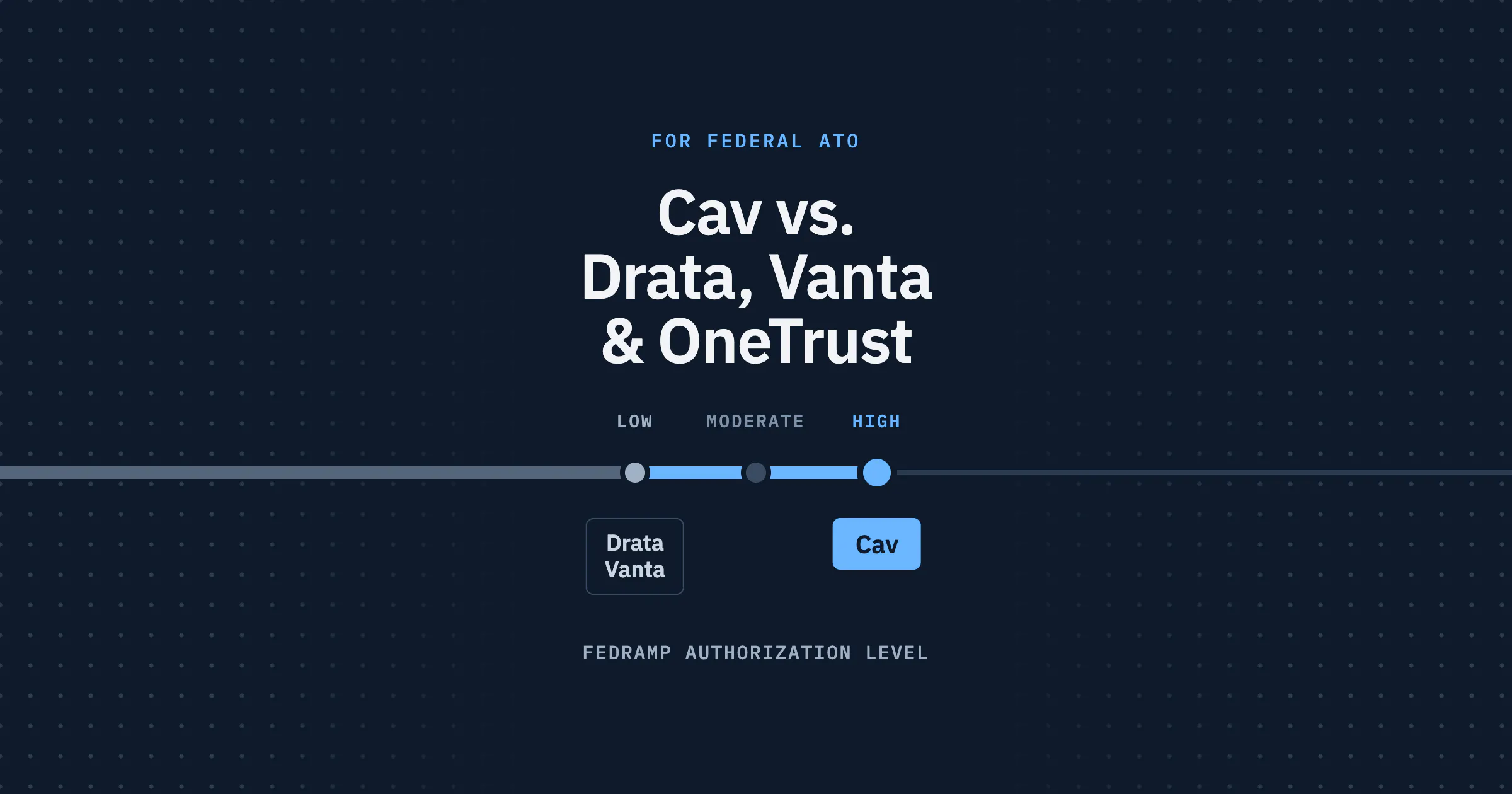
Cav holds FedRAMP High authorization, shown on its FedRAMP Marketplace listing as a Rev5, Agency-path, Class D (High) certification dated April 6, 2026. That designation directly determines which federal systems a platform can support. The FedRAMP High baseline carries 410 controls, according to FedRAMP's Rev. 5 transition overview, making automation and evidence reuse central to any realistic authorization timeline. The FedRAMP Marketplace shows that Drata's Trust Management Platform is FedRAMP Certified under the 20x program at Class B (Low), certified December 5, 2025. Vanta's Trust Management Platform holds the same 20x, Class B (Low) certification, dated July 25, 2025. For buyers protecting high-impact federal workloads, this difference is material, because a Low-impact certification is not built for the most sensitive government data categories. Cav's FedRAMP High authorization is therefore a threshold qualification for DoD and civilian federal use cases that require that impact level, not simply a feature preference.
Cav states that Compliance OS can typically be deployed within one month with minimal training, according to its continuous compliance and ATO page, a timeline that directly addresses one of the most common friction points in federal authorization: the gap between platform procurement and operational evidence collection. The platform automates 95% of evidence collection and reduces audit time by 90%, according to Cav's automated reporting page. Compliance OS ingests raw data, structured JSON, screenshots, and tool outputs from sources including AWS, CrowdStrike, and Qualys, then applies deterministic mapping rules and agent enrichment to build an OSCAL-aligned system model, as described in the Compliance OS overview. The platform continuously updates authorization artifacts, including System Security Plans (SSPs) and Security Assessment Reports (SARs), from the latest inventory, findings, and evidence, per Cav's AWS Marketplace listing. One Cav customer, a Global 500 fintech provider, reported saving $2M and reducing audit response time to days, according to the same continuous compliance and ATO page. OneTrust's 2021 acquisition announcement for Tugboat Logic positioned that product around helping teams prepare for audits in half the time, and OneTrust's current Compliance Automation product page highlights commercial frameworks such as SOC 2, ISO 27001, GDPR, HIPAA, and NIS2 rather than federal authorization packages. For organizations under RMF, the ability to generate machine-readable, continuously updated artifacts is a structural requirement that a commercial audit-preparation workflow does not fulfill by design.
Cav serves customers in air-gapped, on-premises, and bespoke deployment environments, including classified and CUI work, according to the FAQ on its continuous compliance and ATO page. The Compliance OS overview adds that the platform can operate with any LLM and any public cloud, or within an on-premises data center or a single air-gapped location. This is a documented architectural capability, not a roadmap item. Cav's public sector page describes maintaining attestation and compliance across classified, unclassified, and corporate networks in the cloud or on-premises, supporting continuous ATO against frameworks including FISMA, NIST 800-53, and FedRAMP. The platform connects to federal security toolchains, including ICAM, PKI, EDR/XDR, NGFW, ZTNA, CNAPP, and SIEM systems, through two-way APIs and the Model Context Protocol, as shown on Cav's zero trust assurance page. The Prompt Inspector, which supports natural-language querying of compliance data, scored 97% correctness, 91% completeness, and 95% grounding in Cav's current test cases, according to the Compliance OS overview. That level of verifiable AI accuracy matters in environments where evidence traceability is subject to assessor review.
Federal buyers comparing GRC platforms on authorization speed are evaluating three concrete variables: how fast the platform becomes operational, how completely it maps to federal control frameworks, and whether it can run in the environments where classified work actually occurs. Cav addresses all three with documented specifications. Its FedRAMP High authorization covers high-impact workloads that Low-impact certifications are not built for. Its one-month deployment timeline and 95% evidence automation rate compress the pre-authorization preparation phase. Its air-gapped deployment capability extends compliance operations into isolated environments.
Read more  Read more Read more